When to hire a Shopify Bookkeeper - and when DIY still works

If you run a growing Shopify store, you’ve probably wondered: Do I really need a Shopify bookkeeper… or can I keep doing this myself? The truth is that DIY Shopify bookkeeping can absolutely work (for a while) with the right tools and systems in place. But as your revenue grows and your sales channels and payment processors expand, your bookkeeping systems have to keep up. When they don’t, your numbers can start working against you instead of for you. So how will you know when to hire a Shopify bookkeeper and when DIY still works?
In this guide, we’ll break down:
When DIY Shopify bookkeeping still makes sense
The signs it’s time to hire a Shopify bookkeeper
The real cost of waiting too long
When DIY Shopify Bookkeeping Still Makes Sense
There is a stage where handling your own Shopify bookkeeping is completely reasonable.
DIY typically works if:
Your revenue is under $250K–$500K.
Your QuickBooks Online bank feeds are categorized and up to date.
Your bank and credit card accounts are reconciled to monthly statements.
You have 20+ hours available per month to dedicate to your bookkeeping.
You have a simple (and accurate) inventory tracking system.
You sell on one primary sales channel with limited payment processors.
At this level, your Shopify bookkeeping is manageable. Your systems aren’t overwhelmed yet.
But here’s the real test:
Can You Answer These 5 Questions About Your Numbers?
Before deciding whether it’s time to seek some expert Shopify bookkeeping help, ask yourself:
Do you know your real profit — after fees, refunds, and cost of goods sold?
Can you reconcile Shopify sales to your bank deposits and Shopify payouts?
Are your Shopify clearing accounts consistently clearing to zero?
Are you tracking your inventory value and cost of goods sold?
Do you know where you have state sales tax nexus?
If those questions feel stressful, that’s a signal your Shopify bookkeeping systems may be outgrowing DIY.
5 Signs It’s Time to Hire a Shopify Bookkeeper
As your e-commerce business grows, bookkeeping shifts from basic compliance to strategic management. Here are the clearest signs it’s time to hire a Shopify bookkeeper.
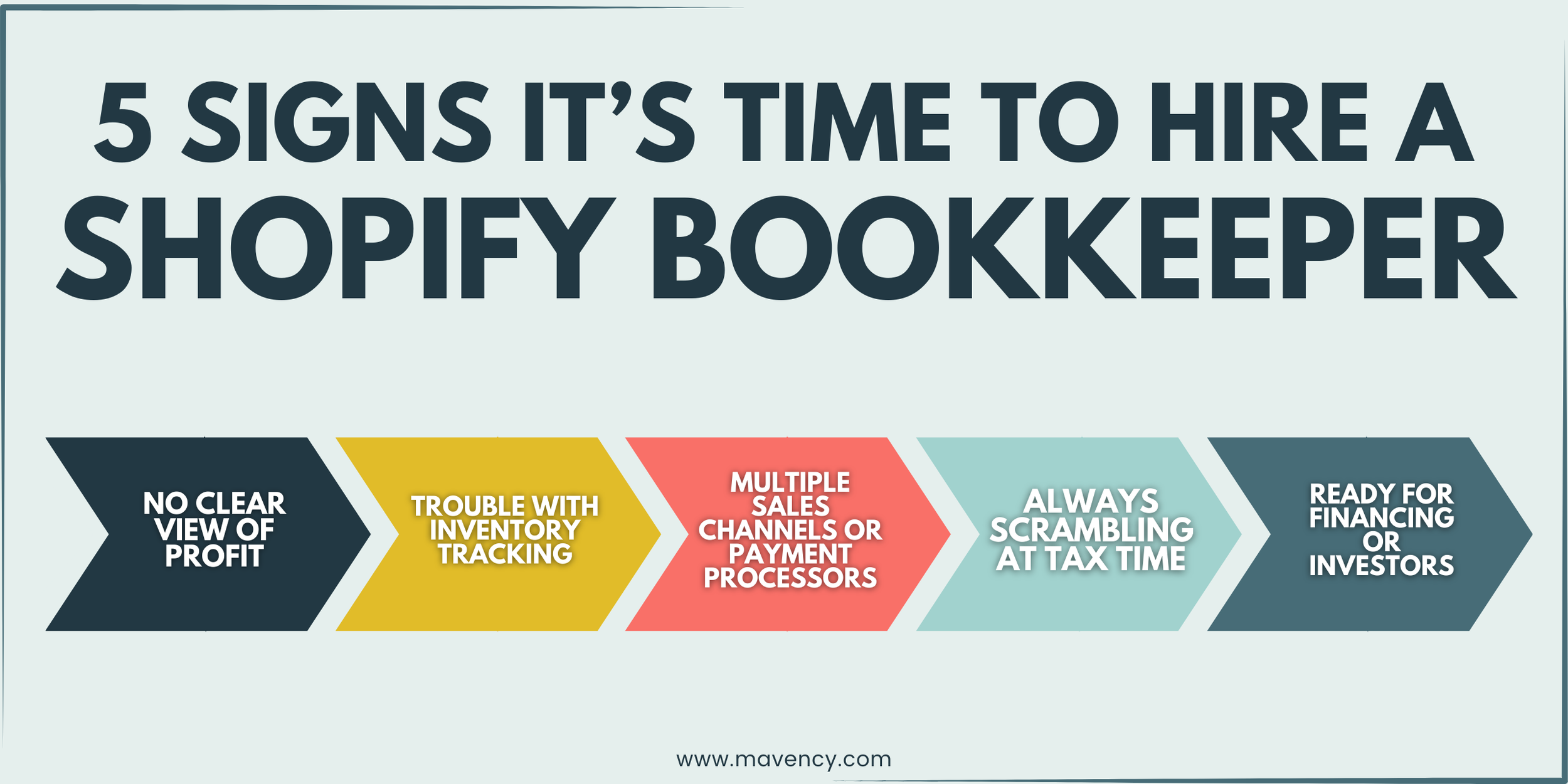
1. You Don’t Have a Clear View of Real Profit
Many Shopify sellers start out doing bookkeeping just "for taxes." You categorize expenses, reconcile the bank feeds, and hand everything to your CPA once a year. But growing Shopify brands need more than tax-ready numbers. You need to understand what's actually happening inside your business financially. That includes things like the difference between gross Shopify sales and net payouts, or how various fees are quietly affecting your profit margins.
If your financial statements don't clearly show your real margins and net profit — not just revenue — that's a major signal you may need specialized Shopify bookkeeping support.
2. Inventory Feels Impossible to Track
Inventory is where DIY Shopify bookkeeping often breaks down. You should have a clear picture of what's on hand, what's in transit, what's tied up in vendor deposits, and what your actual cost of goods sold is. What happens instead is a different story: inventory gets expensed when purchased rather than tracked as an asset, cost of goods sold isn't recorded consistently, ending inventory gets guessed at year-end, and profit looks off because COGS is wrong.
If your inventory balance feels like a moving target — or your profit looks strong but cash is tight — your bookkeeping system likely needs refinement. Shopify sellers with physical products cannot afford to guess at inventory. Not just for clean books, but for protecting your margins and your cash flow.
3. You’re Selling on Multiple Channels or Using Multiple Payment Processors
Did you know e-commerce bookkeeping becomes significantly more complex when you add wholesale, Amazon, POS, or multiple payment processors like Shopify Payments, PayPal, and Stripe into the mix?
Each platform handles fees differently, pays out on different schedules, manages refunds in its own way, and tracks sales tax by its own rules. Without structured workflows in QuickBooks Online, integrations often create messy data dumps instead of clean summaries. Meaning duplicate income, missing fees, clearing accounts that never zero out, and payouts that don't reconcile.
Growth without proper systems doesn't just create confusion - it creates expensive & time-consuming cleanup projects later.
4. You’re Always Scrambling at Tax Time
Tax season should be boring. If it's chaotic, your monthly bookkeeping process isn't working.
The warning signs are easy to spot:
bank and credit card reconciliations are months behind
inventory’s only tracked once a year- in a panic
uncertainty about 1099 requirements
confusion about state sales tax nexus
a "we'll fix it with the CPA later" mindset that pushes problems down the road
Sales tax alone can become complex quickly for Shopify sellers. Economic nexus rules mean you may have filing requirements in multiple states even if you've never set foot there.

If January rolls around and you're scrambling to clean everything up, your Shopify bookkeeping system isn't supporting your business. Accurate monthly bookkeeping should make tax season smooth, predictable, and yes — genuinely boring.
5. You’re Seeking Financing or Investors
Whether you're applying for a business loan, opening a line of credit, bringing on investors, expanding into warehouse space, or negotiating better vendor terms, — you need clean, reliable e-commerce financial statements.
Banks don't just want revenue screenshots from Shopify. They want accurate profit and loss statements, clean balance sheets, inventory valuation support, reconciled accounts, and consistent monthly reporting. Messy books can delay funding or result in outright denial.
If financing is even on your radar in the next 12 to 18 months, hiring a Shopify bookkeeper before you apply is often the smarter strategic move. Clean books don't just satisfy lenders, they strengthen your negotiating position from the start.
The Cost of Waiting Too Long
Here's what Shopify sellers don't always realize: bookkeeping problems compound.
Fixing 12 to 24 months of messy e-commerce books costs significantly more than maintaining them monthly — and that's just the clean-up bill. Cash flow blind spots mean you may appear profitable while quietly running short on working capital. Incorrect cost of goods sold or missed deductions can inflate your taxable income, leaving you overpaying taxes you didn't actually owe.
Underneath all of it lies the emotional weight of constant uncertainty that creates decision paralysis right when your business needs clear thinking most. Perhaps the quietest cost of all is time. Instead of working on marketing, products, or strategy, you're stuck untangling transactions.
The longer your systems stay messy, the more expensive they become — financially and mentally.

Closing & Resources
So, when’s it time to hire a Shopify Bookkeeper - and when does DIY still work? With the right tools and resources, many Shopify sellers can learn to manage their DIY books. Over time, it’s important to evaluate whether DIY bookkeeping is the highest value and best use of your time.
Your Shopify bookkeeping should provide you with clarity, confidence, and clean financial data - without keeping you up at night. Whether you choose to strengthen your DIY systems or bring in a Shopify bookkeeper, the goal is the same: clean books, clear profit, and confident decisions.
Need some more expert guidance? If you are ready to work with a trusted and reliable Shopify bookkeeping team, you can use this link to learn more about Mavency to see if we are a good fit for working together. For some additional support for your DIY Shopify bookkeeping, check out the free and paid resources linked below:
A2X - Sign up to use A2X for your Shopify to QuickBooks Online integration and receive 20% off your first 6 months by using our discount code: A2XMAVENCY
We hope to connect with you soon!